
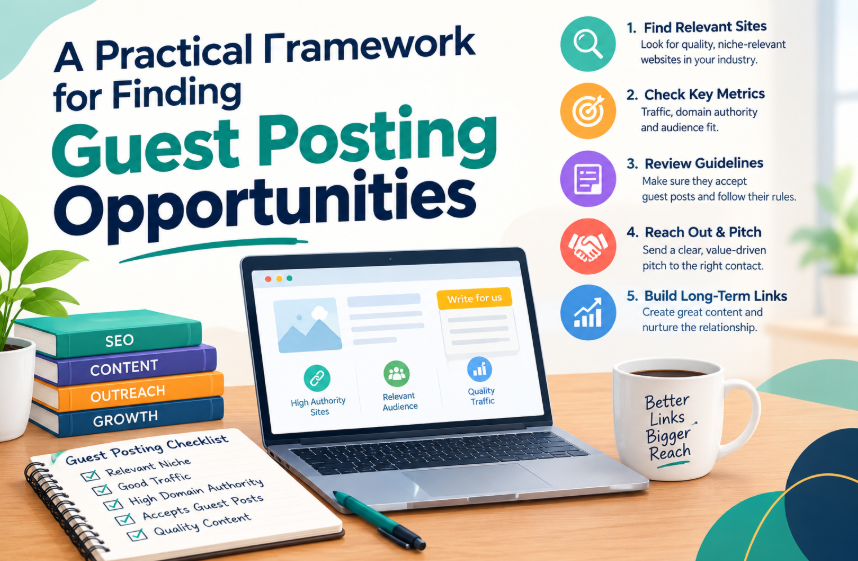
Guest posting can help a business reach a relevant audience, demonstrate expertise, and earn referral traffic. The challenge is finding sites where a contribution makes sense—not simply collecting a long list of domains. A good prospect has readers who may care about your work, publishes useful outside contributions, and offers a clear editorial fit. With a systematic search and a few quality checks, you can build a focused list rather than sending generic pitches to every site that accepts submissions.
1. Define your niche and audience
Start by describing the topics you can write about and the people you want to reach. “Marketing” may be too broad; content strategy for independent ecommerce brands or technical SEO for developers is more specific. List the questions your audience asks, the problems your business solves, and the adjacent subjects that would interest the same readers. This gives you useful search terms and helps you judge whether a potential publication is genuinely relevant.
It can also help to set a goal before prospecting. If you want awareness among product managers, a small, active industry publication may be more valuable than a large general site. If your priority is referral traffic, look for a readership likely to click through to a resource that supports the article.
2. Use search queries to uncover prospects
Search engines are a straightforward starting point. Combine a topic phrase with terms that suggest a site accepts contributions, such as “write for us,” “guest article,” “contributor guidelines,” or “submit an article.” Try several variations and related subtopics; publications do not always label their submission pages in the same way.
For example, a web development company might search for phrases around website performance, developer tutorials, and technical product design, then add a contribution-related term. Save promising results in a spreadsheet with the site name, submission page, contact details, and a note explaining the fit. A broader list of practical prospecting methods can help you expand this initial search without losing sight of relevance.
3. Study where competitors contribute
Look at the bylines, author pages, and external articles published by businesses or experts serving a similar audience. Their placements can reveal publications that accept outside voices, including sites that do not advertise an open submission process. Search an expert’s name alongside a topic or review the “as seen in” and press sections on company websites.
Treat competitor research as a source of leads, not a reason to copy their pitch or topics. Check whether the publication still posts regularly, whether the audience overlaps with yours, and whether its editorial standards suit the kind of article you can provide.
4. Explore professional communities and social platforms
Editors and writers often share requests for contributors, themed issues, or article pitches in professional groups and on social platforms. Follow publications in your field, join relevant communities, and pay attention to the discussions rather than dropping a pitch immediately. Conversations can show what readers care about and help you identify editors or contributors to approach.
Industry newsletters, podcasts, and event speaker lists can also lead to suitable sites. A publication that regularly covers a specialized topic may welcome a practical article from someone with direct experience, even if it has no obvious “write for us” page.
5. Check editorial fit and site quality
Before reaching out, read several recent articles. Note the publication’s tone, typical length, subject depth, and intended reader. Look for original reporting or useful analysis rather than pages filled with thin, repetitive posts. Check whether the site has published recently and whether its content receives meaningful engagement.
Do not rely on a single SEO metric to decide. Search visibility can be one signal, but it does not tell you whether the audience is right or the editorial relationship is worthwhile. Also review submission rules and any stated policies about links. If the site’s content is unrelated to your field or appears to exist mainly to publish paid links, move on.
6. Pitch a specific, useful idea
A strong pitch shows that you understand the publication. Address the editor by name when possible, suggest one or two distinct headlines, and explain the reader benefit in a few sentences. Include a brief description of your relevant experience and links to writing samples if requested. Avoid sending a mass email with a generic topic and an immediate request for a backlink.
Make the proposed contribution useful even if the reader never visits your website. A clear checklist, original lessons from a project, or an explanation of a difficult process is more compelling than a lightly rewritten overview of a familiar subject. Follow the publication’s pitch instructions and give the editor time to respond.
7. Organize the work and follow through
Track each prospect’s status: researched, contacted, follow-up due, accepted, or declined. Record the pitch date and any editorial requirements so that you do not send duplicate messages or overlook a response. If accepted, agree on the topic, deadline, format, and link policy before drafting. Deliver clean copy, respond constructively to edits, and share the published article with your own audience when appropriate.
If writing, editing, or research capacity is limited, a freelance marketplace such as Osdire can be one place to find support across writing and marketing, alongside many other service categories. Its pricing is flat, and buyer payments are held while an order is underway and released after the delivered work is approved. As with any freelancer, agree on the brief, authorship, and quality expectations before work begins.
Conclusion
Finding guest posting sites is a process of matching audience, subject, and editorial standards. Start with focused searches, use competitor and community research to discover less obvious opportunities, then assess each site before pitching. A smaller list of well-matched publications is easier to approach thoughtfully—and more likely to produce contributions that benefit both the host’s readers and your own marketing goals.